Introduction
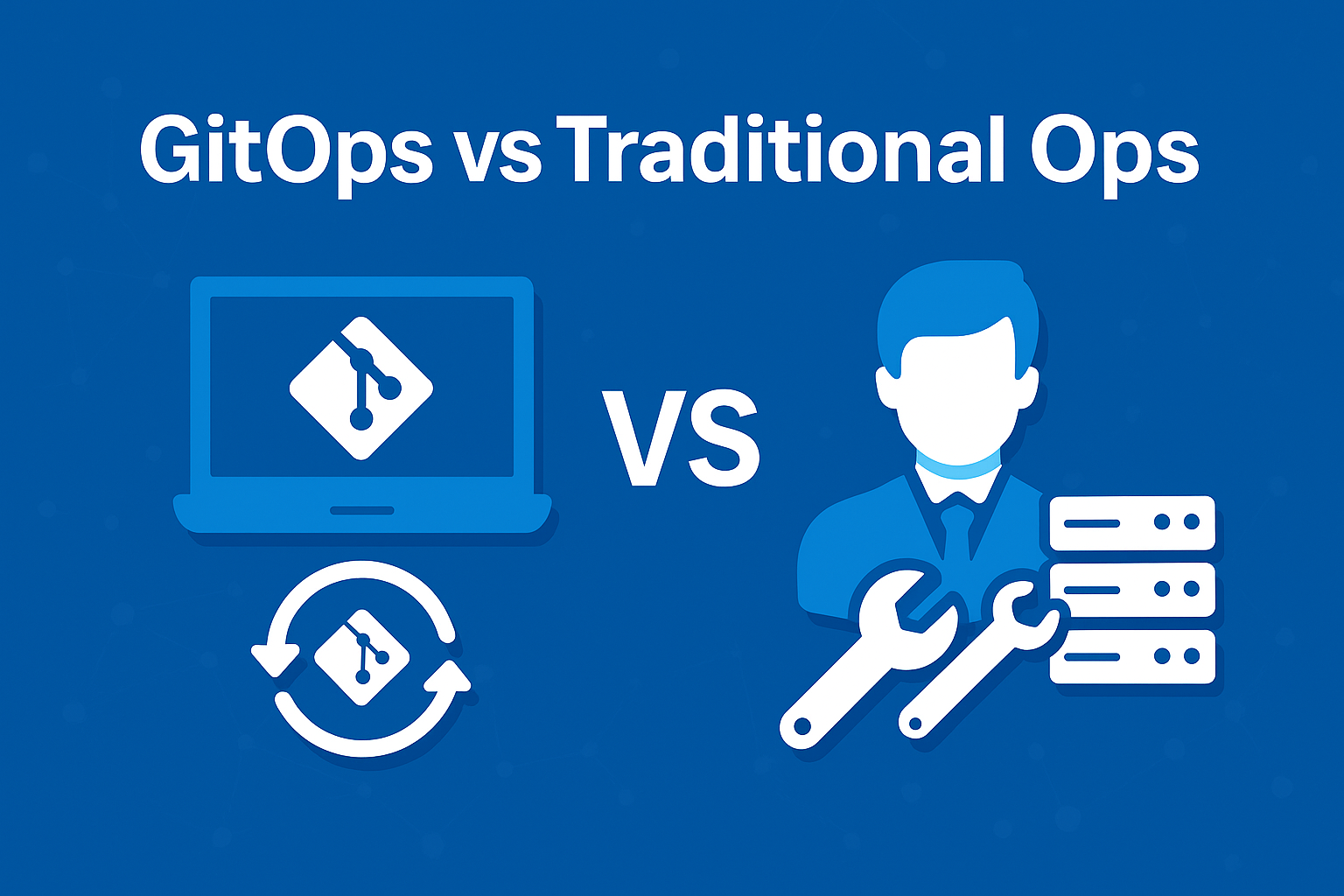
Infrastructure used to be configured manually — servers were patched, networks were updated, and environments were built through scripts and ad-hoc tools. This model completely breaks down in modern cloud-native systems.
GitOps introduces a revolutionary paradigm: everything is declared, versioned, and automated through Git, reducing operational risk and ensuring predictable deployments.
1. Traditional Ops: The Old Way
Traditional operations suffer from:
- Drift between environments
- Manual hotfixes that leave no audit trail
- Siloed operations teams
- Slow release cycles
- Inconsistent configurations
- “Works on my machine” issues
This makes systems fragile and difficult to scale.
2. GitOps: A New Operational Mindset
GitOps treats Git as the single source of truth for:
- Infrastructure
- Application manifests
- Security policies
- RBAC configurations
- Cluster states
Changes are made via pull requests → reviewed → approved → automatically applied.
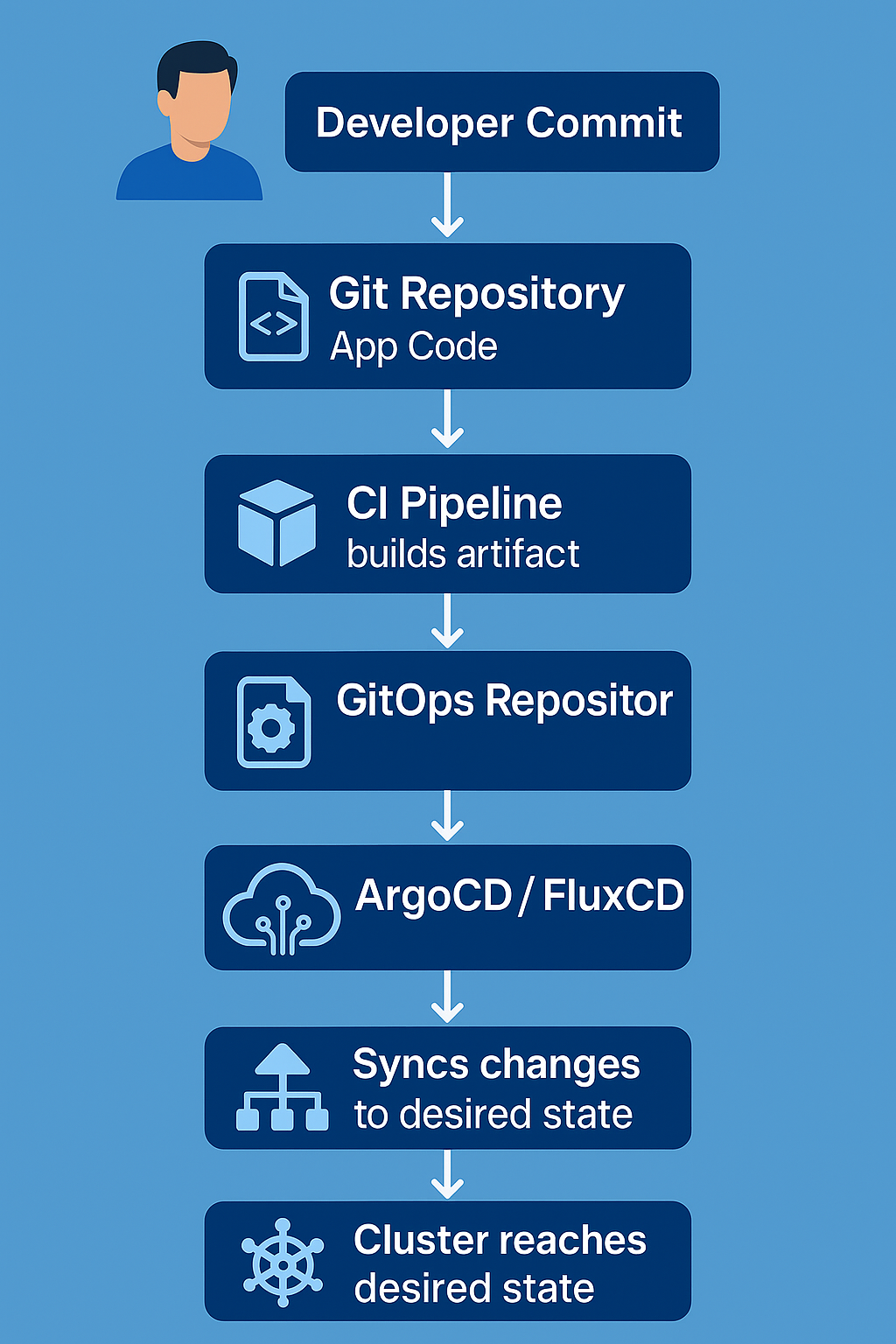
3. The GitOps Pipeline
GitOps workflow includes:
- Developer creates a pull request
- Infra code is validated and scanned
- Merge → triggers reconciliation
- Controllers (ArgoCD/Flux) sync the cluster state
- Drift detection ensures cluster = Git
Zero-touch deployments become possible.
4. Enterprise GitOps Benefits
- Security: All changes are traceable
- Compliance: Immutable audit history
- Speed: Deployments are automated
- Consistency: Environments never drift
- Scalability: Works for 100s of clusters
- Rollback: Revert Git commit → instant rollback
5. GitOps for Multi-Tenant Platforms
Multi-tenant SDV/DevOps platforms must enforce strict separation.
GitOps enables:
- Per-tenant repos
- Per-tenant policies
- Automated workspace provisioning
- Consistent Kubernetes configuration
Traditional operations rely on manually editing servers, running scripts, updating environments individually, and reacting to problems after they happen.
This model fails in cloud-native ecosystems where:
Hundreds of microservices deploy daily
Multiple teams share Kubernetes clusters
Infrastructure is ephemeral
Multi-tenant configurations must not drift
Audits, compliance, and governance are strict
DevOps teams manage 100s of environments
GitOps is the modern evolution — an operating model where Git is the single source of truth, and deployment automation continuously syncs the desired state to infrastructure.
This guide explains how to implement GitOps end-to-end using ArgoCD/FluxCD, integrated with GitLab CI/CD, in real-world environments.
🔷 1. Why Traditional Ops Fails in Cloud-Native Systems
❌ Manual changes cause environment drift
Dev → QA → UAT → Prod never match.
❌ No audit trail
Engineers make changes with no history.
❌ Rollbacks are painful
Fixing a bad deployment means reversing changes manually.
❌ Ops teams are overloaded
Too many one-off environment tasks.
❌ Hard to scale
More services = more scripts = more failure.
GitOps solves these problems with predictability and automation by design.
🔷 2. What Is GitOps, Really? (Clear Definition)
GitOps means:
Git = the desired state
Automation = reconcile state
Clusters self-correct drift
Deployments become automatic
Rollback = revert Git commit
Audit = Git history
GitOps doesn’t replace CI/CD.
CI handles build/test, GitOps handles deploy.
🔷 3. GitOps Architecture Overview
GitOps Repo is the heart of the system — it contains:
Helm values
K8s manifests
Policies
Versioned app configs
🔷 4. Step-by-Step GitOps Implementation Guide
⭐ STEP 1 — Create the GitOps Repo Structure
Recommended structure:
This clean separation is key for multi-team/multi-tenant clusters.
⭐ STEP 2 — Install ArgoCD or FluxCD
ArgoCD (recommended):
UI dashboard
Drift detection
Rollback
Sync wave ordering
Per-app permissions
FluxCD:
⭐ STEP 3 — Configure GitOps Controller Access
ArgoCD needs permission to:
Pull from Git repo
Apply manifests
Read cluster state
Sync changes
Set RBAC policies carefully, especially in multi-tenant setups.
⭐ STEP 4 — Standardize Deployment Templates
Use Helm charts or Kustomize.
Helm is preferred for SDV/Cloud workloads.
Example values file:
Each environment overrides values.
⭐ STEP 5 — Integrate CI/CD With GitOps
The CI pipeline pushes:
Built image → registry
New tag → GitOps repo
Example GitLab CI step:
This triggers ArgoCD automatically.
⭐ STEP 6 — Configure ArgoCD Sync Policies
Choose between:
Manual Sync
Good for production.
Automatic Sync
Best for dev/staging.
Auto-Prune
Deletes resources removed from Git.
Self-Heal
Cluster fixes drift automatically.
Sync Waves
Order deployments (DB → API → UI).
⭐ STEP 7 — Implement Multi-Tenant GitOps
For each team:
ArgoCD Projects define boundaries:
⭐ STEP 8 — Add Drift Detection & Notifications
ArgoCD detects drift if:
Alert via:
Example:
🔷 5. Real-World Workflow Example
Release workflow for workspace-api (SDV platform)
Developer pushes MR
CI → build + scan + test
Image published → registry
CI updates GitOps repo with new version
ArgoCD detects Git change
Deployment applied
App Insights monitors health
Grafana dashboards update
GitOps logs environment history
Rollback?
ArgoCD auto-syncs.
That's the power of GitOps.
🔷 6. Best Practices
Repository
✔ Separate app and environment repos
✔ Use semantic version tags
✔ Do NOT store secrets in Git
Helm
✔ Use shared chart libraries
✔ Keep values small & isolated
GitOps Policies
✔ Enable auto-prune
✔ Use sync waves
✔ Implement self-healing
Governance
✔ Enforce PR reviews
✔ Protect main branch
✔ Maintain version history
Observability
✔ Use ArgoCD metrics (sync_status, health_status)
✔ Add cluster dashboards
🔷 7. Common Pitfalls & Solutions
❌ Using GitOps without CI
You still need CI to build artifacts.
❌ Overusing environment-specific logic
Use environment overlays instead.
❌ Deploying secrets through Git
Use:
Azure KeyVault
SOPS
Sealed Secrets
❌ No RBAC boundaries
Multi-tenant clusters require strict isolation.
🔷 Conclusion
GitOps transforms how modern cloud teams operate:
Deployments become predictable
Clusters self-heal
Configuration drift disappears
Audit trails become automatic
Rollbacks become simple
Multi-tenant platforms become manageable
GitOps is a mandatory practice for Kubernetes, cloud-native, SDV, and large enterprise DevOps platforms.