Introduction
As the automotive world shifts from hardware-driven ECUs to Software-Defined Vehicles (SDVs), cloud architecture becomes a fundamental enabler. Digital Twin platforms allow OEMs and Tier-1 suppliers to simulate thousands of driving environments, test ECUs, validate algorithms, and reduce physical testing costs.
In this emerging ecosystem, cloud architecture must support massive compute loads, real-time data ingestion, concurrency, and multi-tenant isolation — all without sacrificing cost efficiency or security.
1. Why Cloud Matters for SDV
- SDVs need continuous OTA updates
- ADAS/Autonomous software requires large-scale training and validation
- Digital Twins must simulate millions of driving scenarios
- CI/CD pipelines must handle ECU software builds, tests, and deployments
Traditional data centers cannot scale to meet these dynamic workloads. Only the cloud offers elastic compute + global reach.
🚗 The Future of Cloud Architecture for SDV & Digital Twin Platforms
A Complete Implementation Blueprint for Automotive Engineering Teams
Software-Defined Vehicles (SDVs) and Digital Twin Platforms are transforming the automotive engineering lifecycle. Instead of relying solely on physical testing, OEMs and Tier-1 suppliers now use cloud-scale simulation, virtual ECUs, CI pipelines, and real-time telemetry to accelerate development.
This blog provides a detailed implementation guide — architecture, workflow, security, data flow, DevOps pipelines, and deployment strategies — based on real-world production environments used by modern automotive OEMs.
1. Understanding SDV & Digital Twin Platform Requirements
A modern SDV engineering environment needs:
Functional Requirements
High-scale simulation environments (VDK, HIL, SIL)
Digital Twin workloads (vehicle models, scenario generation, algorithms)
OTA software versioning & distribution
Interfacing with embedded ECUs & microservices
Telemetry ingestion from vehicles + simulators
Multi-location collaboration (Japan, Europe, India, USA)
Non-Functional Requirements
Multi-tenancy for different engineering teams
Security, RBAC, policy enforcement
High-performance compute (GPU/CPU)
Fast CI/CD pipelines
Observability & reliability
Cost optimization
Hybrid connectivity to on-prem labs
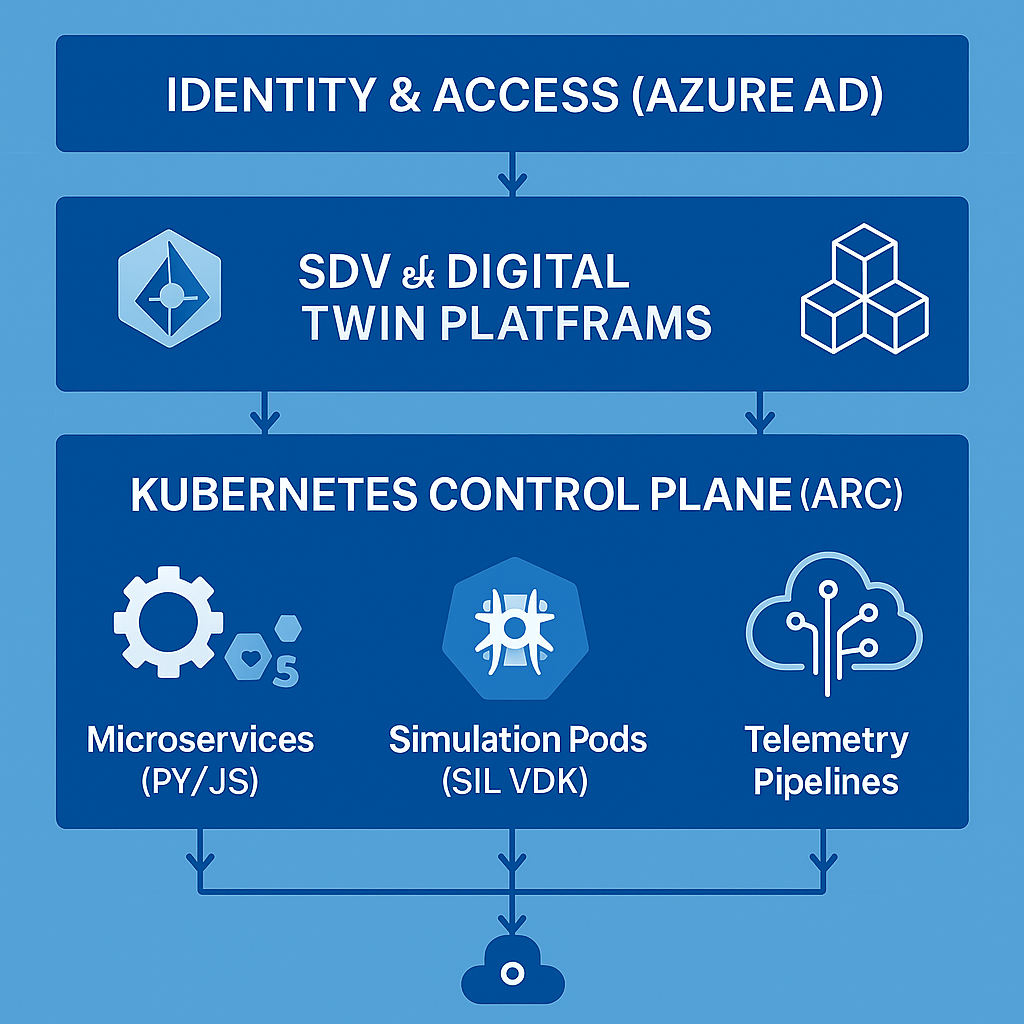
2. Reference Cloud Architecture (Azure + AWS Hybrid)
Below is a logical architecture used in real deployments:
This reference design supports:
✔ multi-team scaling
✔ hybrid lab integration
✔ SDV simulation workloads
✔ multi-cloud extension
3. Implementation Steps: End-to-End Architecture
Step 1 — Identity & Access Integration (Azure AD)
Identity forms the backbone of SDV cloud security.
Implementation Checklist
Configure Azure AD tenant
Create Entra ID App Registrations
Enable SSO (OAuth2 / OIDC)
Define RBAC for each tenant/team
Apply Conditional Access Policies
Enforce MFA for privileged roles
Implement Managed Identities for services
Outcome
Users authenticate securely, APIs trust verified users, and services run without hardcoded secrets.
Step 2 — API Management Layer (API-M)
APIs in SDV platforms expose:
Simulation control interfaces
Vehicle digital twin models
Scenario generation endpoints
Telemetry ingestion
Platform metadata APIs
Implementation Steps
Create Azure API-M instance
Import OpenAPI specs from each microservice
Apply rate limits (per tenant)
Apply JWT validation
Add IP filtering for sensitive APIs
Expose developer portal with auto documentation
Outcome
A secure, discoverable, throttled API gateway for all engineering teams.
Step 3 — Kubernetes Infrastructure (AKS + Arc)
Kubernetes enables scalable workloads for simulation & microservices.
Cluster Design
Implementation Steps
Deploy AKS cluster
Attach on-prem clusters using Azure Arc
Apply NetworkPolicies
Deploy Ingress Controller (NGINX or AGIC)
Configure secrets via Key Vault CSI driver
Install metrics (Prometheus + Grafana)
Install logging (FluentBit → Log Analytics → Kusto)
Outcome
A unified, hybrid Kubernetes environment enabling VDK simulations, microservices, ECUs, and batch workloads.
Step 4 — SDV Workload Implementation (SIL/VDK/HIL)
VDK (Virtual Development Kits)
Containerized ECU software
Simulation of CAN/LIN/Ethernet
Device model virtualization
Integrates seamlessly with AKS
SIL (Software In Loop)
HIL (Hardware In Loop)
End-to-End Execution Flow
Outcome
Full digital validation pipeline replacing manual testing.
4. Data & Telemetry Architecture
Telemetry is essential for SDV cloud platforms.
Data Flow
Implementation Components
EventHub for ingestion
Azure Functions or Spark for transformation
Kusto cluster for analytics
Grafana for real-time dashboards
Long-term storage in DataLake
Outcome
A scalable telemetry pipeline supporting millions of events per minute.
5. CI/CD Implementation (GitLab + Airflow)
CI Steps
Build container image
Run code quality checks
Security scans (SAST, DAST, SCA)
Generate Software Bill of Materials (SBOM)
Push artifact to registry
Deploy to AKS via ArgoCD or GitOps
CD Steps
ArgoCD monitors Git repo
Deployment changes auto-applied
Canary or blue-green rollout
Auto rollback if health checks fail
Airflow Integration
Airflow orchestrates simulation workflows using DAGs such as:
Outcome
Fully automated SDV build → test → deploy → simulate pipeline.
6. Multi-Tenancy & Workspace Isolation
SDV platforms typically serve:
ECU teams
ADAS teams
Simulation teams
Cloud teams
Validation teams
Isolation Mechanisms
Outcome
Each team works independently without affecting others.
7. Observability, Monitoring, & Usage Analytics
Core Components
Usage Tracking
Track:
Active users
Simulation count
Workspace consumption
Cost graphs
API usage
Outcome
Engineering leaders get visibility into platform adoption and performance trends.
8. Cost Optimization Architecture
SDV simulations can be heavy, so cost optimization is critical.
Strategies
Use spot GPU nodes for simulations
Auto-scale HPA/VPA
Turn off workloads during off-hours
Implement data retention policies
Optimize multi-cluster usage
Monitor cost with FinOps dashboards
Outcome
Efficient cloud usage with 20–40% cost reduction.
9. Security & Compliance
Security Controls
Outcome
Meets OEM/Automotive-grade compliance & cybersecurity standards.
10. Final Architecture Summary
This cloud architecture supports:
✔ High-scale SDV simulations
✔ Digital Twin workloads
✔ Hybrid integration with labs
✔ Secure multi-tenant operation
✔ Automated CI/CD pipelines
✔ DX-friendly engineering workflows
✔ Enterprise-grade scalability and observability
It is the backbone of modern automotive software development.
🎯 Conclusion
The future of automotive engineering is cloud-first and simulation-driven.
A well-architected SDV + Digital Twin platform accelerates development, improves product quality, and reduces dependency on expensive physical infrastructure.
With Azure, Kubernetes, API Management, GitLab, Airflow, and hybrid connectivity — engineering teams can finally build vehicles like they build software.